Omaha’s Own

Was it Matt Hill or back in the day
to Mike McGee? 

Exercise your common sense.  Rankings, the BCS, 
and the Big East come and go.

Do the Right Thing!


Good Morning Mr. Agau.  Should you decide to undertake this mission the following will apply.  

1)  Should you go BCS.  Take an offer from the highest profile school(s) that offer.  You will have excellent high visibility from the media, from pro scouts, and thanks to mucho television, from a national fanbase.  

2)  BCS schools offer excellent landgrant educations, and the private BCSer’s also offer a quality product.

3)  BCS schools offer the best chance to go pro.  

4)  Unless you choose Nebraska, Mizzou, or Kansas…it is a long swim back home…and your folks will not see many of your games.   


Remember Matt Hill?  Matt decided to go BCS, to the U of Texas.  He became one of many 3 to 4 star recruits that year to sign with the Longhorns.  Unfortunately a Maryland recruit named Kevin Durant also signed that year.  Matt got lost in the mix…and rode pine.

Durant went 1 and done…however UT signed additional 4 and 5 star recruits the following year…Matt continued to warm the bench, with an occasional minute or so in blowout games.  

To his credit Matt Hill graduated, but never got a glimpse to reach his playing potentials at the BCS level.  Too many good to great players flooding through the system, and it really is surprising that he was never requested to leave to make room for incoming guys (as is done at many BCS schools – UConn, S’Cuse, Louisville, UK, KU, others).  

Actually, the last truly successful guy from Omaha, who went BCS, was Kerry Trotter (Cr Prep), who went to Marquette back in the late 70’s or early 80’s.  
His graduating Sr. competitor was Ron Kellogg (Om North) who went to KU, but was not a blinding success there.  The aforementioned Mike McGee (Om North) was merely okay at U of Michigan in the early 80’s.  

All of the above is to say this.  The most successful Omaha hoopsters stayed at home…and became Creighton Bluejays. There were a couple of exceptions, of course (a couple of kids played at Utah State, Omaha University, and of course…Fred Hare at Nebraska.).  

The items listed in numbers 1-4 above are not exclusive to BCSer’s.  Creighton has everything the BCSer’s have, except large numbers of students.  

The media will be here in Omaha…and continue to be here when you and the 2013er’s come aboard.  We’ve got an excellent basketball program, an exciting uptempo style of play, and good players.  You will fit in well…and in time will become the star.  Winning always attracts media attention.  Being ranked always attracts media attention.  Now there is a high probability of significant NCAA Runs in March (and I want my NCAA National Championship by the 2016 Creighton Basketball Centennial celebrations!).  

Academically, Creighton is the Best university in the entire Midwest, and #1 in its’ category nationally (Princeton Review and US News and World Report mags).  Academically it doesn’t get better than at CU.  

Rodney Buford, Kyle Korver, and Anthony Tolliver are recent CU grads in the pro game.  Others are playing overseas (Kenny Lawson, Booker Woodfox, Nate Funk).  Both Gregory Echenique and Doug McDermott will probably go pro after this season.  If a player is good enough, the pros will know about him, find him, and sign him.  We see it every day – a player from a mid major makes good in the pros.  nuff said.  

Lastly, and most importantly… Omaha has one of the highest Sudanese populations in the country.  It is good for ordinary folk to see one of their own kids do well, do very well…not just see blurbs on the television or read about it in the WH.  Stay and play locally.  So your parents, relatives, friends, former classmates, and the greater Omaha community can all participate in it.  

We will all enjoy watching your growth and development…watch you help lead the Jays to several championships on the conference and national levels.  
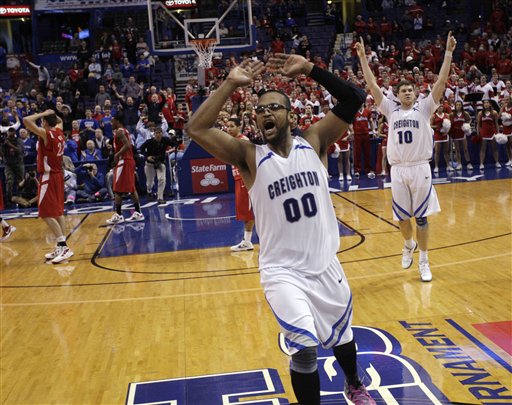


Should you decide to accept this challenge, this mission, Mr Agau, the Secretary will disavow all knowledge of this mission. Except to say 2 things… 

(AKOY IS A JAY!)    and

(Welcome Home Akoy…You’ve made a Great choice in becoming a Creighton Bluejay!)  

As Ossie Davis (as the old street bum) told Spike Lee in the movie: 
“Do the Right Thing!”  

Be a Creighton Bluejay Akoy Agau, do the right thing!

   love ya, 
   gtmoBlue


On Clickians

family: Canidae /Saudiae

Eastern Whining doglike humanoids

Clickians:  Near humanoid-like creatures of the family Canidae (Saudiae)/genus Clicciaciae that are of slight build, thin haired, pot-bellied, swarthy, dull muddied complexions, with varied colorations- mainly light blue with differientiating markings, and the majority have a prehensile, hairless black tail.  Most are equipped with split grey tongue, and have the ability to multi-speak, that is to talk from several sides of their mouths simultaneously (faceted larynx)*, a true family Saudiae trait.  Western Mountain Clicks (Clicciaciae Mountainieri) are the only variant with a non-prehensile tail.  Both the Clicciaciae Wildcaticus and the Volunterianii are tail-less.   Although their primary mode of communications is to whine incessantly.  Western Clicks tend to emit robust barks, rather than the incessant whining of their eastern (North and South Carolinian) brethren.
Clickians are generally accepted within the scientific community as belonging to the Phylum Chordata.
 phylum Chordata,  class Mammalia, order Carnivora, family Canidae or Saudiae*, genus Clicciaciae**, and species (6 main, with some discussion of up to 9 species).  
** Not to be confused with Clactonian:  of or relating to a Lower Paleolithic culture usually characterized by stone flakes with a half cone at the point of striking.
General morphology: Coloration: Generally Baby Blue, but scientific discourse states there are 6 main variants (some argue there are up to 9).  Some in the scientific community divide the genus into North and South variants.  We do not support such divisions.  All true Clicciaciae have prehensile hairless black tails and have been known to rest, hanging from tree limbs.  True Clicciaciae, especially the Tarheelicus, are incessant whiners.

They are pack animals and generally travel in large groups.  When in pack they are often, loud, boistrous, and self congratulatory.  Walking around patting each other on the back and eagerly licking, kissing, and sniffing each others hindparts.  True Clicciaciae, especially the Tarheelicus, when idle or alone is more than content – like all dogs – to lie about smiling and contentedly self-cleaning it’s own genitalia and hindparts.

When excited, under duress, or stress, they will turn on each other.  Under extreme stress true Clicciaciae, of the main variants; will attack, and kill-wound-maim the smaller, standoffish Dookii.

Clicciaciae Tarheelicus – Solid baby blue coloration with distinctive black feet, occasionally with white spots or pattern along both sides.   Loudest and most incessant whiners of the genus.  Incessant self-cleaners.  When excited, under duress, or stress, they will turn on each other, and have been known on occasion to eat their young.  Tarheelicus species glow an eerily fluorescent blue in the dark and when stressed, as evidence to the actuality of the 1978 Rocky Mount incident.  Whine on, Tarheelicus, whine on!


Clicciaciae Dookii – Baby Blue with dark blue and black side spots/markings.  Has broad dark blue stripe down its’ mid-back.   Has tufts of dark blue-black hairs on forehead, resembling horns.  Smallest numbered species within the genus.  Workaholic species of the genus.  Envied by and often attacked by the other Cliccaiciae species.


Clicciaciae Forestiae –  Baby Blue with gold side markings, broad gold stripe down mid-back.  Generally nondiscript.


Clicciaciae Wolfpacciae – Baby Blue with red side markings and broad red stripe down mid-back.  Generally nondiscript, but with occasional flashes of hyper work activity.


Clicciaciae Nogamecockii (Southern Red Click) All Dark Red coloration with white side marks and white mid-back stripe.  Sometimes wearing a red/white patterned Shemagh head covering.  Bottom of the genus pecking order.


Clicciaciae Clemsoniae (Tiger Click) Bright Orange with blue mid-back stripe, no side markings.  Generally nondiscript.  Tends to walk in large concentric and or circular patterns, looking at and sniffing its’ own glow-in-the-dark orange tracks.
The following genus’ have been recently found to have Clickian origins, although none possess prehensile tails, do not multi-speak, and tend to bark rather than whine.  Therefore most authorities do not consider the following 3 species to be true Clickians.  
Clicciaciae Mountainieri (Western Mountain Click) Baby Blue with dark blue square side markings, and a blue/gold tiger patterned stripe down mid-back. Pink, non-split tongue, unable to multi-speak, a  non-prehensile tail, and barks instead of whines.  (Previously thought to belong to the family Cercopithecinae.)
Clicciaciae Wildcaticus (Western Blue Click or the “Jim Beam” Click)  Dark Blue with white mid-back stripe, no side markings.  Normal morphology with exceptions of barks rather than whines, and is a Tail-less Click.
Clicciaciae Volunterianii (Western Yellow Click or the “Jack Daniel’s” Click)  Misnamed as “yellow”, this species is Bright Orange in coloration with white mid-back stripe, no side markings. Normal morphology with exceptions of barks rather than whines, and is a Tail-less Click.

Clickians are generally known for their loud, piercing whining, which can be heard for miles.  With the advent of internet and video streaming…they are now heard world-wide.  Prior to the 1978 nuclear accident at Rocky Mount , NC; Clickians were generally only seen in their native habitats.  After the Rocky Mount incident (beginning in the early 1980’s), Northern Clickians are now seen in great numbers on the roads throughout North America, with their distinctive blue and white (1st in Flight-an apt discription) license plates.  They have become the whining ‘gypsies’ of the continent.   Southern Red and Tiger variants are mainly seen outside of their normal habitat in Alabama, Florida, and the greater Washington, DC area.
Female Clickians will attest to the speed and effeminate nature of the males mating rituals, with Clemsoniae holding the mating speed record, at just under 15 seconds.  The average Clickian can easily consummate the mating act in under 2 minutes.  Western Clicks generally mate drunk and therefore have reasonably longer mating periods, although most interbreed within their immediate family groups, giving rise to genetic malformities and abnormalities.  Western Mountain Clicks will mate with shoes on (provided that they own a pair of shoes).